DATES ON POSTER WRONG!!!! SHOULD BE THE MONTH OF OCTOBER 2019!!!
"So Long, My Son" could well be called "So Long this Movie", as you would have had 3 hours taken away from your life if you had watched it. It is something the producer and director Wang Xiaoshuai ought to reflect on.
There are numerous extraneous scenes that could have easily landed on the editing room cutting floor and had it reduced to a 90-minute film. There are also numerous confusing scene flashbacks that are swapped in-and-out among three time zones within the story. I think if the editor had wanted to confuse the audience and then call it art, then he would have certainly succeeded.
While the film has interesting content, the tensions are not built up gradually into a climax, but instead they go through a repeating saw-toothed up-and-down journey on a relatively flat plain. This makes it quite a drag at times.
The film won the Silver Bear (Best Actor & Best Actress) awards in the 69th Berlin International Film Festival this year.Wang Jingchun and Yong Mei definitely deserve the award, as they fleshed out their characters brilliantly. Their characters go through a series of excruciating grief - the grief of losing their son, of losing friends, of finding them back, of living through the changing political climates in China,...etc.
In all, it is a film worth catching if you do not mind killing 3 hours away. In the era of Youtube and Netflix, I suspect this will not go down well with the majority of people.
I watched it at the Asian Film Archive's Oldham Theatre.
Crazy Rich Asians the movie, brought a horde of netizens screaming about the lack of minority representation in the movie - that among the super-rich in Singapore, only the Chinese are depicted. The online and offline press were abuzzed with such outcry, with the local tabloid, The New Paper, joining in the fray. See, "Crazy Rich Asians should have been called High SES Chinese" by columnist S.M. Ong (The New Paper, Sept 3).
The article hits a little 'below the belt' in some parts (see quote below), but then, hey it is a tabloid. What do you expect?
Quote:
Dear Kevin (the author),
….
Not everyone in Singapore is Chinese as depicted in the movie, they complain.
But that's not your fault.
Coming from old money yourself, you emigrated from Singapore at age 11 and evaded national service so you probably didn't get to interact much with other races here.
"As a child, you're cloistered in this world," you said in an interview.
"You don't know how other people live until you leave that world and realise not everyone has an airplane in their garage."...
Unquote.
While I respect the opinions of those crying out loud, I too have my views, so I wrote to them and was surprised to get it published.
Here:
(A rewrite of the print, in case display resolution is poor in small devices.)
No reason for Crazy Rich Asians to be like MediaCorp drama
I refer to the article "Crazy Rich Asians should have been called High SES Chinese" by columnist S.M. Ong (The New Paper, Sept 3).
I assume the article is written tongue-in-cheek and I should take it with a pinch of salt. Crazy Rich Asians in not a documentary. It is a film version of a book based on the author's observations of super-rich Chinese in East Asia. So let it be.
Minority inclusion in this instance and context is not necessary. I would hate to see it turn out like a MediaCorp drama with minority races artificially inserted. That is understandable for MediaCorp as it is a national broadcaster.
But this movie has not such obligations or objectives. Neither should it set out to sterilise or pontificate. It is fiction. It is satire. Cut it some slack.
Audiences don't want to watch real life. They want drama, art with creative licence to entertain.
For all movie reviews in this blog (including this post), click here.
If you are in your 50s or 60s that have lived the pop scene in Malaysia-Singapore in the 1970s, you must watch this movie. It is based on the real story and teen years of Singaporean singer-composer Dick Lee - with lotsa drugs, sex and music.
Such films wouldn't have been possible, say ten years ago, with our censorship board in this draconian part of the world.
To the younger audiences, this may be your chance to take a peek at how your parents might have lived their lives once upon a time. And understand why they may be nagging at your hanging out with friends during the wee hours of the morning - knowing the perils lurking in the dark.
"WonderBoy" will bring you monumental detail of nostalgia, like: buying your first cigarrette and taking that timid first puff; and your crush on school boys in all-white uniforms, or girls in blue pinaforte at your favourite bus stops in town. And also those house parties and slow dances where very soon you find everyone else snogging away like hippies.
The trailers:
y.
z
I particularly like the concern for details to the locations, set design and props used in the movie. Like the choice of colours that symbolises the psychedellia presiding in youths as they stoned their brains away frolicking, amid high colour saturation and smooth camera movements bringing the surrealism to the surface.
The film is well scored musically, as it should be with Dick at the helm, directing it with the help of Daniel Yam, a director that has made films that literally got millions of people cry their hearts out all over the world. This is Dick's first time directing a film, as in a non-stage production.
I would rate "Wonderboy" highly as a musical with great cinematography and acting.
Benjamin Kheng carried the nervous and frustrated teen and lead character very well, so did the rest of the main cast delivering their parts.
However, I do find the script a little weak with relatively flat character arcs. Also, while I like all of Dick's compositions, I find the last song in the film, sang by Dick himself, a little out of place. But I won't spoil your fun by telling you,l. Go and watch the film and find out.
UPDATE:
.
---------------- ------------------------------- COMMERCIAL BREAK: This is MM2's first foray into an English language movie. Do support, so that it will pave way for future such films to be made.
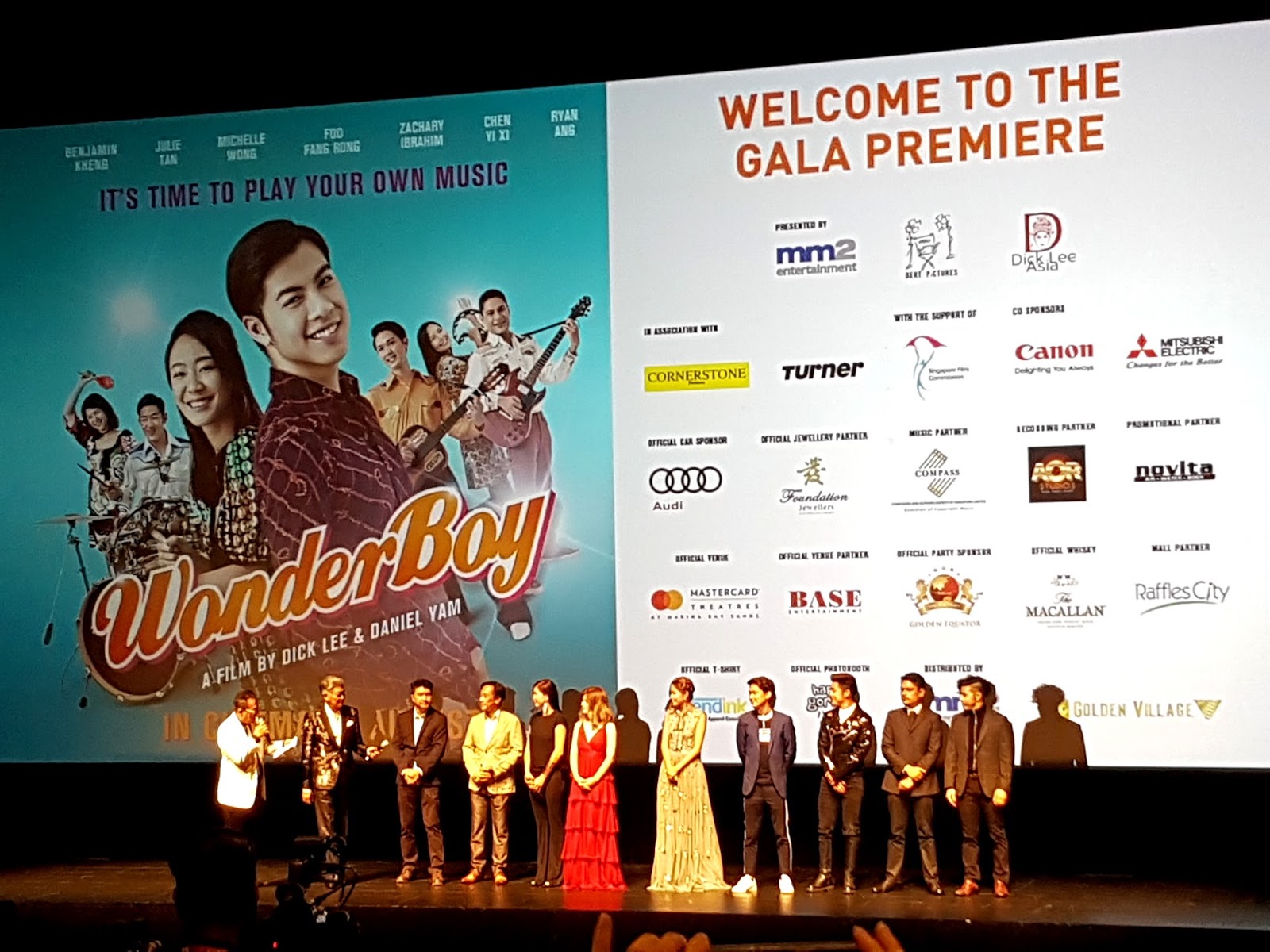
"WonderBoy" movie premiere gala @ Marina Bay Sands Mastercard Theatre, Singapore on 1 Aug 2017.
Kung Fu Yoga is clearly a sign that Chinese movies have entered the market of big budget visuals involving multi-national co-productions, breathtaking sceneries, fast cars, fights and dashing good looking actors.
Jackie Chan plays the part of a Chinese version of Indiana Jones, an archeology professor/treasure hunter that takes on the bad guys in exotic places - a well tested plot. Add that with Jackie's actions and humour and you get a sure winner.
What is most outstanding in this Jackie Chan movie is that it captured some fascinating and daring skirmishes with nature, like the dive into a deep icy lake inside a colossal cave in Iceland and the scene with lions and hyenas. The latter no doubt done together with CGI, but still it is impressive. It is probably the first Chinese movie to do so in this scale.
The dive into the icy lake is an amazing feat for any actor, let alone for Jackie, as he had a surgery just two days before the act, to realign his intestines. At 62, he is a legend, still doing his own stunts.
Go watch Kung Fu Yoga. You will be entertained.
From Variety.com (5 Feb 2017): “Kung Fu Yoga” dominated the foreign box office, racking up a hefty $51.4 million. The action-comedy with Jackie Chan represents the union of two of the largest film markets — China and India. It was backed by companies in both countries and has resonated with audiences in both places, grossing $177.9 million globally. From Firstpost.com (5 Feb 2017) Kung Fu Yoga earned US $ 138.8 million (around Rs 940 crore) at the box office in China alone during the first week of its release. That is double the estimated cost of the film. Notably, the film’s takings are already way higher than the worldwide collections of India’s most successful film, Dangal. More importantly, it reminds us of the size of the Chinese market and the drawing power of Jackie Chan.
Trailer:
Interview 1:
Interview 2:
.
Behind the Scenes:
And about the man himself - Jackie says that he is happiest when making movies.
This is the 115th posts. To date, this blog has garnered more than 101,000 hits. Thank you for visiting the blog and your support. For other movie reviews in this blog, click here.
Go watch "The Apprentice", written and directed by Boo Jun Feng, when it comes to a theatre near you. The movie premieres in Singapore on the 30th June 2016. Get your family and friends to watch it too.
"The Apprentice" is Jun Feng's second feature film after "Sandcastles" (2010) which was screened at Cannes Film Festival's International Critics Week. "The Apprentice" too made it to the Cannes Film Festival, and was screened at the Uncertain Regard section.
This film took five years from conception to release. I watched it at the Singapore Film Society's screening on the 25th July 2016 and was fully captivated by the smooth and detailed depiction of the apprentice Aiman's (played by Firdaus Rahman) journey to learn the ropes of the trade (pun intended) from the Master Executioner Rahim(played by Wan Hanafi Su). Mastura Ahmad plays the role of Suhaila, Aiman's sister. All three actors in the main cast acted very convincingly - very necessary for a film like this, ultimately leading the audience to feel that they are watching a documentary more than a fiction,
Death penalty and execution are morbid topics and the film represents that through dark and grey visuals, long and lonely corridors and the menacing crisp clear clanging of the jail gates. I won't spoil your fun further watching the film. This film is unique. It tells the story through the psyche of the executioner through ultra realistic visuals and emotions.
Go watch it. Support Singapore Films.
Here is the trailer...
Here are the interviews with the director himself.
Ding Hu, a retired Chinese Central Security Bureau officer suffering from dementia, struggles to protect a little girl from triad vendetta.
Sammo Hung plays the lead role, Ding, very believably, as the overweight and deceptively sluggish retired officer. Ding goes through his day in his usual routine, only punctuated by a little girl who sneaks into his house for sanctuary whenever she has a quarrel with her dad. The relationship is likened to be one between a grandpa and granddaughter, and hence the Chinese title which translates to something like, "Special Agent Grandpa".
Though overweight and old, Ding springs into astonishing agility as he defeats the gangsters in brutal knife attacks and gang clashes. This was delivered with extremely elegant action choreography and camera work, using extensive mid shots to bridge the rapid actions.
It is said that Jackie Chan was supposed to play the role of Ding, but at that time was too busy attending to his son's brush with the law for drug abuse. While I think Jackie would have delivered the action sequence well, I feel that Sammo has given the character the added vulnerability of an old man who has lost his hope in life and resigned to witnessing his own memory eroding away.
The main location was shot in Suifenhe, a riverside trading town in Heilongjiang, along the border of Russia and China; with some scenes shot in Vladivostok. The exoticism of the small town (population around 100,000) was adequately captured with the many beautiful aerial and crane shots.
The granddaughter Cherry, is brilliantly played by a lively 13-year old Jacqueline Chan, who despite her young age, has already appeared in seven other feature films. In the story, Cherry breaks Ding's mundane life and brings joy to him by sneaking into his house, chatting with him, and taking those long walks and fishing excursions - what many grandfathers can easily relate to.
There are several big names of the past making their cameo appearances, like Karl Mak, Shek Tin and Tsui Hark, who play the role of the three old men by the railway station watching the world pass by amid their idle banter. That not out of place at all if shown in a British skit like The Benny Hill Show, had they spoken English.
There are also newer big names, like Eddie Peng, providing eye-candy to the female fans and younger crowd. I suppose big names do boost box-offices, though I think just the engaging plot, touching moments and the great delivery by the lead actors are more than enough to hold the audience for the entire length of the film. The producers, among them, Andy Lau, probably thinks it is no harm playing it safer adding those big names. Why not, when you can afford them?
The Bodyguard combines both drama and action, amid the exotic northern border cultures of Russia and China. The story eventually wraps up very cleanly with all the bad guys killed in gang clashes or arrested by the dutiful and efficient Chinese police force. That probably to appease the Chinese authorities to allow them to produce a movie with the background of organised crime.
It is said that dementia hits those who have such deep sorrows in their life that they strive to forget. This appears to be the case for Ding with the several milestones in his life that he would rather had happened differently. This is some food for thought. This movie is both entertaining and inspiring. The inspiring part is a surprise coming from an action movie. It is also a reminder to some in the audience who ought to be choosing the healthier route of letting go of the past and to start living again.
I managed to squeeze some time out today to watch "Filial Party", as I have promised Boris Boo, the director, that I will do so.
I was suitably entertained by the well
researched local stories that I think the heartlanders and common people in Singapore would relate very well to. They are little stories surrounding
parents, children's emotional baggage of their parents passed and
living, money, materialism, middle-age joblessness, old age senility,
extra-marital affairs... etc. All told through big comedy expressions popular in Malaysia and Singapore.
In think Boris' jokes
are a little more subtle and less slapstick as those of Jack Neo, a local film maker who has consistently scored at the box office. I like the
dialogue of mixed languages of English, Mandarin, Cantonese, Hokkien, Malay and Tamil - that offers the feel of street level Singapore. However, I wonder if those outside Malaysia and Singapore would be able to follow the dialogue or would find the linguistic cocktail amusing enough to embrace. For more about the use of standard language or otherwise, click here.
In short, the story is about a reality show that requires its participants to demonstrate their filial piety to their parents - in the process going through the sub-plots of sob stories and dilemmas - many of which question the moral fabric of today's society.
Lastly, like many other local productions, product placements are strong in this movie and one can certainly be forgiven for thinking of it as a Prudential Show at some point. A bit of subtlety would have been helpful, as research
shows that subliminal advertising is way more effective. Perhaps the sponsors did not see it that way.
Overall, I think the
movie is much better than what was said in the Straits Times film review. I
like my film to both entertain and inspire, and that I think "Filial Party" has achieved!
At a film festival recently, Hong Kong actor Andy Lau said in jest that he is expensive because he is worth it. This is also why I feel "Firestorm" is worth watching. However overall, the movie fails to lead the audience into a believable action-thriller..
But after accepting some excesses and fantasies, I felt that I need to draw a line at some point in the movie.
In a nutshell, the plot capitalises on the bad guys' superiority in the robberies and consistently keeping a few steps ahead of the game. They are better than the police in ground intelligence, technologies and firepower, and moreover are a dab hand at shooting on target at the police, while they themselves would miraculously escape death and bullets. This despite being widely exposed to gunfire most of the time - well, not until the very end when they too get gunned down.. But the real thorn in the eye is not the above-mentioned visual gimmicks, but the other logical contradictions that stand in the way.
For instance, why didn't the police use their ability to trace IP addresses and GPS locations of the baddies; or simply arrest the crane operator that lifted the police armour car? Wouldn't that be easier than searching the myriad of CCTV footages from the cameras dotted around the city?
Okay, I am no party-pooper, as afterall, movies are fantasies and we all need some. I did enjoy the great escapism that are expected of such movies - the gun fights; the grenade blasts; the fist fights that fall several floors down and yet hit the ground running (pun intended).
What stands out in this movie is also the computer graphics (CGI) of the colossal damages by the bombs and blasts - very impressive by Asian cinematic standards.
I would consider "Firestorm" to be a big budget visual action-thriller rather than one that is character driven and inspirational. If you go with such expectations, then you will probably be more forgiving and not be disappointed.
"American Dreams in China", directed by Peter Chan, is about three young men who grew up yearning to make it to the US for the American dream during the post-Mao era when China was going through sweeping economic reforms. As it resulted, only one of them, Meng Xiaojun (played by Deng Chao), managed to pass the visa interviews and board the plane to America. Ironically, after facing many trials and tribulations in the States, Meng returns later to join the other two, who had remained, to make their 'American Dream' happen in China.
The film depicts the lead characters' struggles between the old system of communist education and bureaucracy versus the free market economy which is creeping into China at a breathtaking pace in the 1980s. Together with the opening up of the Chinese economy came the need to speak English and embrace the free market as espoused by the flagship of America, the Chinese people's symbol of freedom and prosperity, at that time.
The story of "American Dreams in China" is the epitome of the determination and sacrifice of the Chinese people to achieve what they want when opportunities arise amid relative chaos with the arrival of the free market. The motivation of the Chinese students to learn English and to do well in the TOEFL examinations reminds me of my own days as a student seeking to study in the West in the early 1980s. Many of the accusations by the American academics surrounding their suspicions of Chinese students' cheating in exams, didn't surprise me a little bit. I have heard those prejudicial remarks and worse before, first hand. Watching it on screen still evoke some anger, but at the same time a delight that at last we have progressed and are able to beat the West in their education system and their brand of market economy.
The three main actors fleshed out their characters very well in the movie. Meng, as one who has been transformed in the US and is now back to teach his old buddies about the American Way. His hard and harsh assertions clashing with the conservative Cheng Dongqing (played Huang Xiao Ming), thus testing the relationship of the trio who are as close as brothers. The disputes occasionally moderated by the Bohemian and carefree Wang Yang (played by Dong Dawei).
I would recommend anyone who wants to experience the story of the struggles of three good friends who go on to build a business empire, to watch this film.
I had the privilege to watch it during the special screening on the 10th September 2013, courtesy of Clover Films. Thank you. I love special screenings and galas, as they are occaions when happy people gathers to celebrate, and in this case, to celebrate an inspiring movie.
There has been some criticisms about the movie not doing justice to the book "The Great Gatsby", which culminated locally in Singapore's Straits Times Life Section article on the 20th May 2013. And so I gave my two cents worth and it got published! :)
"War has rules, mud wrestling has rules - politics has no rules." - Ross Perot
Executive Producers: Amy Sayres, Jon Poll and Chris Henchy.
Producer: Will Ferrell, Adam McKay, Jay Roach and Zach Galifianakis. Director: Jay Roach. Starring: Will Ferrell and Zach Galifianakis Screen play: Shawn Harwell and Chris Henchy, from a story by Adam McKay & Chris Henchy & Shawn Harwell Distributed by: Warner Brothers.
Every four years, there will be political films coming out from the United States with their Presidential Elections. In 2008, among others, we had "W", about the outgoing President George W Bush, produced and directed by Oliver Stone; and "Frost Nixon", by Ron Howard for Universal Pictures.
"The Campaign" is yet another one of such films that attempts to shed some light over the darker side of US Elections, this time by using the brutal punches of slapstick comedy, sex and the championing of the American underdog. This they did well with the unimpressive and naive local tour guide Marty Huggins (Zach Galifianakis) who eventually came out on top, against the flamboyant long time Congressman and philanderer Cam Brady (Will Ferrell), over their North Carolina 14th district. All these apparently a direct poke at real life Senator John Edwards from North Carolina and Democratic Vice President nominee in 2004, and Presidential nomination in 2004 and 2008
The plot centres around the battle between Marty and Cam, utilising the dirtiest of personal attacks that exploit family and sex scandals, the whole deal funded by big corporation money, facilitated by the Motch brothers, purported a satire of the real life wealthy Koch brothers.
The story depicts how an honest and unlikeliest possible choice like Marty can be, with the help of his new benefactors’ support and a ruthlessly sharp campaign manager, can too be converted into a mean, calculating and cunning beast. This climaxes with Marty literally shooting his opponent down with a cross bow.
As election day closes in, the plot thickens and so are the insults that quickly escalate to injury, burying each other in mud-slinging and back-stabbing. There are subtler symbols of trickery and deceit that is cleverly displayed in the film too, but I will leave that you to discover, so that you will enjoy them more.
In an insane twist to the story that broke the camel's back, the wealthy Motch brothers sold the 14th District en-bloc to Chinese businessmen to build factories and also to import their cheap labour en-masse to produce even cheaper goods and double their profits. This scheming maneuvre sent a chill down my spine, as much of this is already happening in Singapore, as the government has brought in Chinese construction companies together with their cheap labour en-masse. This has crowded out the locals and kept wages the same for workers for the last ten years!!! This is surreal! Whether this will be the last straw that will break the camel's back remains to be seen of the Singapore Government.
Despite the many hard hitting political films and the democratisation of information via the Internet, rich people continue to be the puppet masters behind the thin veneer of democracy. Democratic governments wants us to believe that democracy exists in full. The autocrats don't even bother pretending. The current play is that money talks and bull-shit walks. So, the political circus in the US or anywhere else, is here to stay. It will only change when the people change - when virtues pride over greed. Meanwhile, the people deserves the politicians they get, and
politicians deserve the
people they get.
I thoroughly enjoyed watching the movie and laughed my heart out. The guy behind me in the theatre was also laughing and literally almost falling off his chair. So, I would recommend you to watch it too!
If you like the film and/or this blog, you may like to go to the bottom of this page to 'follow' this blog.